Dear Reader,
It seems that after two-ish decades of life, I am only now learning how to breathe (literally… and metaphorically).
Which definitely wasn’t already clear from the other two posts I’ve made on this topic, right? In all seriousness, one of the most important concepts I learned over both my Molecular Biological Sciences AND Modern Dance coursework was the importance of oxygen in healthy muscle tissue.
Breath is, simply, life.
(Cue the dramatic music!)
A Short Scientific Aside…
As I’m sure all of you know, food fuels our bodies by serving as the raw materials for the derivation of Adenosine triphosphate, ATP, or otherwise known as the “energy currency” of the body. The breakdown of glucose and fats into energy via the Krebs cycle is simultaneously awesome as well as every student’s worst nightmare to memorize, but it’s what follows that is so fascinating. Without ATP, the contraction-relaxation of every muscle in the body simply wouldn’t happen. This is because of ATP’s unique ability to “pull” at the head of myosin, a protein, triggering a process that leads to muscle contraction.
But before your body can effectively produce ATP molecules, it relies on oxygen taken in through the breath. Oxygen is a key ingredient– the last step, in fact– in converting glucose into ATP via the Krebs Cycle and electron transport chain.
It’s for this exact reason that you start breathing faster and faster the more that your muscles work and your heart pumps! You need the oxygen in order to keep converting your sugar and fat stores into the energy currency that your muscles need in order to keep dancing, running, or moving in general.
When this system doesn’t quite work or provide as much oxygen as is needed– AKA when you don’t breathe enough– your glucose reserves are converted into lactic acid instead of ATP. You may be familiar with a burning sensation in your calf or quad muscles after a long dance session, and that’s the lactic acid being produced in those muscle tissues! This sensation is a good indicator that your muscles are on their way to complete fatigue.
No matter which way you look at it, breathing deeply and healthily is what allows us to sustain movement. This is applicable even if you aren’t dancing! No matter what form of activity you are engaging in, breath is, simply, life.
I hope that short scientific aside was helpful! I think that we hear a lot of these buzzwords as athletes– lactic acid, ATP– and never really quite understand what they mean, which isn’t helpful to anyone. By understanding a little bit of the science as to how your muscles operate, I hope that it starts to help you build some awareness as to what your healthy boundaries are.
So now, let’s discuss what you all have presumably landed up here to discuss (not the electron transport chain, I assume): how exactly to take the healthiest, deepest breath while you’re moving.
Step 1: Alignment
I know, I know. It all comes back to alignment in one way or another. It’s a frustrating thing to hear, especially when you don’t fully understand WHAT alignment is, or how you should be using it to your advantage. I will say, however, that deepening my understanding of alignment has allowed me to develop really lovely classical lines while I dance, and extreme control over my movement. I think that the investment is worth it.
I’ve reattached the images of alignment from my last post here, just for your reference.
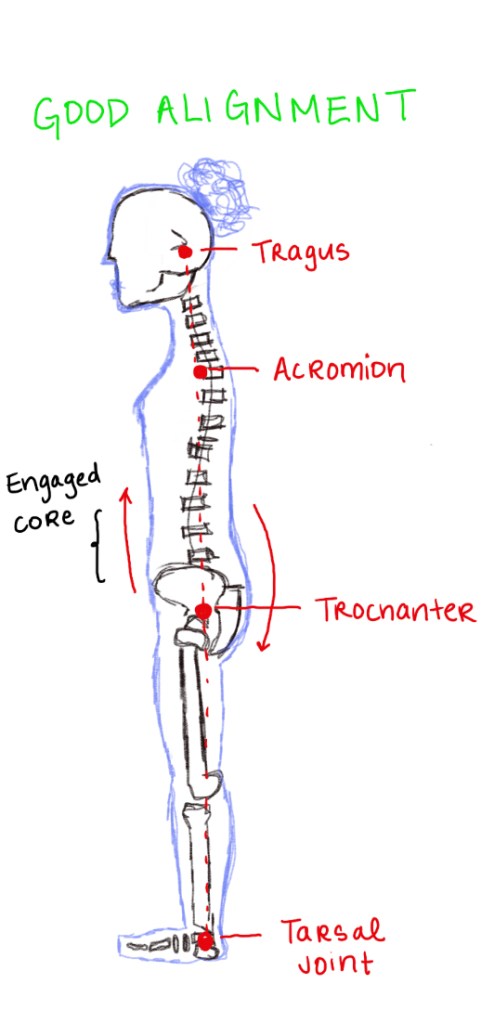
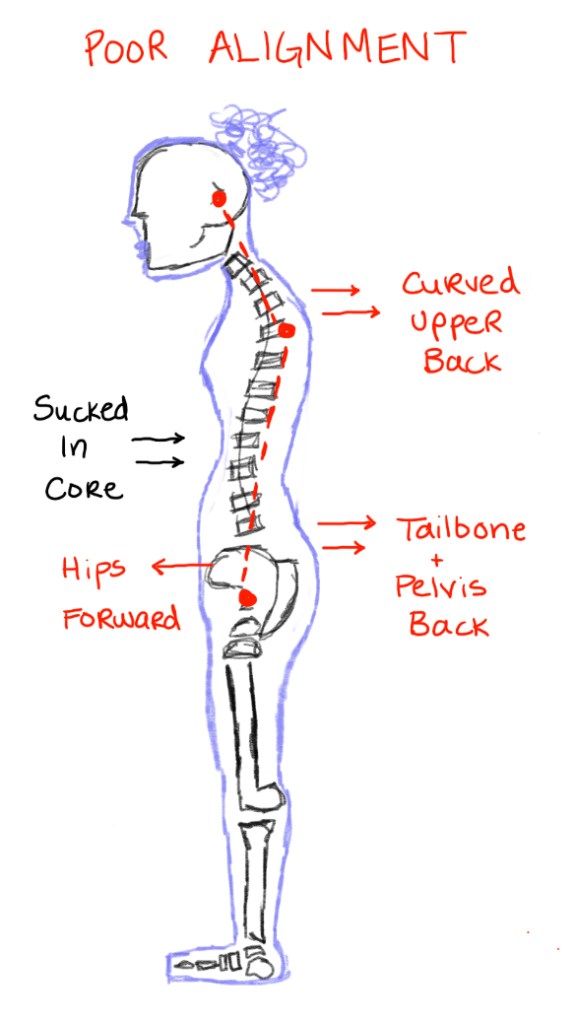
The way that I work on finding alignment is quite literally by standing parallel to a mirror, comparing my body placement to a diagram such as the one above, and then physically using my hands to try to manipulate my placement. You should be able to literally feel your cervical, thoracic, and lumbar spine align with the crown of your head.
While you are standing by the mirror, spread your feet about hip distance apart (or just a bit less). Take your hands, and place them at the point on the back of your skull where you naturally have a small indentation. Without applying much force at all, “pull” the skull up to create a sensation of elongating the cervical spine (i.e., the back of the neck) while the shoulders travel down. You should feel a lovely lengthening feeling.

From here, take a breath in. Roll your shoulders back and down. Chances are that your ribs have opened up to the front, which is a position that we generally want to avoid. To remedy this– and even if you don’t feel a dramatic rib flare– place one hand at the back on the center of the glutes, and one hand on the front of the pelvis on the pubic bone. Your hands should be at about the same level, one at the front of the body, and one at the back.
Imagine a string pulling your pubic bone and pelvis up, while your tailbone and glutes push DOWN. Note that this is NOT the same as tucking under, where your glutes are pushing towards the front body. Instead, just like how we elongated the neck UP, imagine your glutes and tailbone elongating DOWN. This should generate a lovely elongated feeling in the lower back.

Your legs should have a slight bend to them this whole time, and this will really allow your trochanter (or basically your leg-hip joint) to find a healthy position over the foot. And voilà, your weight is magically centered and aligned.
This will feel weird, and it will take time. Keep working on it, because this position will ultimately be the reason you’re still able to bend over, squat, and move around when you’re 80 years old!
Step 2: Finding Healthy Neutral
Healthy neutral and good alignment go hand-in-hand, but it’s worth breaking them down to get a deeper sense of your spine’s position. I like to think that healthy neutral begins with the spine first, whereas alignment begins at the crown of the head, but that’s just my personal take on it.
The first way to exaggerate this feeling is by taking the simple cat-cow yoga stretch. Pause at the fullest arc of each motion to really feel the wave of the spine. This is a great pose because it exaggerates the two extremes of spinal curvature, and when you can feel the extremes, I think that finding a neutral is a little easier. Make sure that the shoulders are rolled back in your neutral, and feel how the core can easily engage when your spine is in healthy neutral.
In my previous post, we discussed how an engaged core is vital in healthy breathing, while the sucked-in stomach is harmful. Well… healthy neutral is the perfect foundation for the engaged core!
While you’ve found your neutral spine on your hands and knees, engage your core by imagining the belly button drawing into the back of the spine. I like to accomplish this feeling by exhaling all the air in my lungs, pulling the belly button in as if I want to hollow out my entire abdomen, and then releasing. Take care to ensure that the spine stays in neutral, and that, my friends, is your transverse abdominis working!
Another great way to find healthy neutral is by curling the pelvis while laying on the back. This is a fabulous exercise that I learned in my sophomore year of my dance degree, and something that I do almost every day.
Begin by laying down on your back with the knees bent and feet on the floor. You should be able to feel your upper and mid-spine pressed into the mat easily. Most of us have a bit of trouble with the lower back. Work on pressing every bit of your spine into the ground so that there are no gaps between your spine and the floor.
From here, curve your tailbone up as if you were to pick your glutes up from the ground. Do NOT use your quads or back muscles; instead, simply imagine curving the pelvis forward. This pelvic isolation is critical in order to be able to find healthy neutral while dancing. You should feel a lovely release in the lower back.
Step 3: Building Awareness While Dancing
The same alignment + healthy neutral combination that you found in Steps 1 and 2 is what you should be aiming for every time you are dancing. It should be your “home base” that you return to, and the foundation for the various stances that you go on to take. For example, if you are performing a developpé, beginning from healthy neutral ensures that the hip does not “hike up” as you extend the leg, and the side body does not scrunch. Instead, you are left with a lovely and lifted position, regardless of how high your leg is. The same principle goes for jumps, turns, etc, in that you should be conscious of your healthy neutral and your alignment to allow for maximum freedom in the limbs.
When your core and spine are engaged in healthy neutral– thereby forming the engaged core position we previously discussed– you are able to take deep, sustaining breaths that fuel your dance at the cellular level.
Let me be the first to say that this is hard! It is supposed to be hard, and if you are struggling, please keep at it. I promise that one day it will click for you. It took me about a month and a half of practicing my alignment three times a week for it to finally click while I was dancing in class, and it was like putting on a pair of glasses for the first time.
Suddenly, everything made sense.
In finding my alignment, it was like I discovered how to dance. I felt like I’d been imitating my whole life, and suddenly, I was truly, genuinely dancing.
I wish the same for each and every one of you! When we understand dance, we dance freely.
That’s all I have for now! To round out this series on breathing, I’m going to make one more post on my favorite breathing exercises, so stay tuned for that coming shortly. Otherwise, please check out these great resources on the science of breathing, and feel free to leave comments to continue this discussion.
Joyner and Casey on the “Regulation of Increased Blood Flow (Hyperemia) to Muscles During Exercise: A Hierarchy of Competing Physiological Needs”
https://www.ncbi.nlm.nih.gov/pmc/articles/PMC4551211/
Ahmad, Wolberg, and Kahwaji on the Electron Transport Chain & Oxygen
https://www.ncbi.nlm.nih.gov/books/NBK526105/




 Welcome to the Home of Anatomy-based Classical Dance™.
Leave a comment